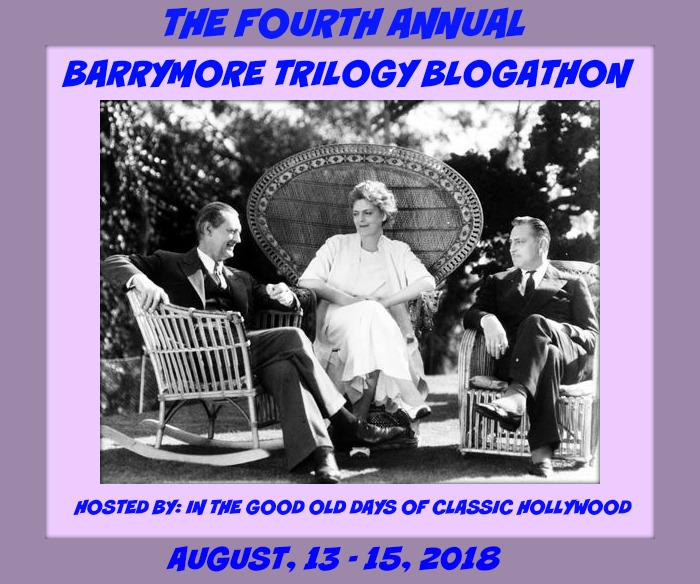
Welcome to my second go-round for the In the Good Old Days of Classic Hollywood Fourth Annual Barrymore Blogathon! I'll be bloggin here on the fifteen Kildare Gillespie films Lionel Barrymore was in--but not on every single film! I'm not THAT nuts! :) Read in good health!
Lionel Barrymore’s career began in 1911 and consists of over
200 films; from 1938 (when he required a wheelchair) through 1953, he made 37
films. He was very popular, in no small part due to his role as Leonard
Gillespie in fifteen Dr. Kildare/Dr.
Gillespie films for Metro-Goldwyn-Mayer, co-starring in the majority with
Lew Ayres. Mr. B’s success acting in a
wheelchair as a person who actually required one is unduplicated. Though I came
to these films via a looping route from Key Largo and a short scene in that
film, I came to this question: How might his success have transformed the
perception of physical disability by the public? I'm not sure I have the answer yet, but let;s look at this phenomenal actor's role as the cranky and brilliant, (pre House, MD) diagnostician who happens to be in a wheelchair, Dr. Leonard Gillespie.
 |
| first entrance of Dr. Leonard B (for Barry) Gillespie, Young Dr. Kildare |
Though the first film utilizing the characters created by
Max Brand was called Internes Can’t Take
Money (Paramount 1937, with Barbara Stanwyck, Joel McCrea as James Kildare,
and I promise I’m not making this up, a character named Mother Teresa!), the
success of the Lew Ayres as Jimmie (their spelling) Kildare and Lionel
Barrymore as Leonard B. Gillespie films meant those two men remained securely
seated in the imagination of Americans. MGM picked up the ball and ran with it
for fifteen films between 1938 and
1947. In four of those years, more than one Kildare film was made—all the more
remarkable because Lionel Barrymore was still appearing in other films for MGM
and on loanout.
To sum up the research I recently did on these films,
viewers will note a 3-part division, approximately, in the course of the films.
This division starts in film one of the 15 film series.
In the first Ayres/Barrymore film, Young Dr. Kildare (October 1938, directed by
frequent helmer Harold Bucquet), Kildare is entering a medical internship at
Blair General Hospital—he’s young, dynamic, smart, and a little impetuous.
 |
| YDK: Kildare can't seem to not tick off Dr. G. |
Kildare comes in to meet the irascible diagnostician
Gillespie who’s already terrorized the group of interns in front of him.
Barrymore looks older, a bit weak, and has quite long hair. Keep in mind this
same year he starred in the epic You Can’t
Take it With You, which was released only a month prior to YDK. Given the
fast turnaround of the Kildare films, he had some time off between the two
films, but this was a busy year for him—perhaps that’s why he looks so tired?
Nevertheless! What’s important is that this film starts the
first of 3 distinct strands of storytelling—we find out Gillespie has a
melanoma on the back of one hand. So, perhaps along with being tired, Mr. B was
playing a part calling for exhaustion. Gillespie continues to terrorize the
interns, nurses, chief of staff, and ambulance driver and comic relief Joe
Wayman (Nat Pendleton), but he is obviously impressed with Kildare. So, we have
a film that could lead to a lot more, or one where we can excuse just one sequel
because Gillespie is dying.
At the end of this first film together, though, Mr. B and
Lew Ayres come out in street clothes and speak amiably to the audience. It’s a
cute scene. Both men aver there will be more—and boy, were there ever more!

YDK was made for just under $200,000; it grossed almost $2.5
MILLION. That’s a ton of money—and so we find our first story arc, that of the
dying doc (and Mr. B in a supporting role for a few films), attenuated for the
next four films.
In order, we have:
Young Dr. Kildare;
Calling Dr. Kildare (28 April 1939); The Secret of Dr. Kildare (24 November
1939); Dr. Kildare's Strange Case (12
April 1940); Dr. Kildare Goes Home (6
September 1940); Dr. Kildare's Crisis
(29 November 1940); The People vs. Dr
Kildare (2 May 1941); Dr. Kildare's
Wedding Day (22 August 1941); Dr.
Kildare's Victory (4 February 1942); Calling Dr Gillespie (9 July 1942); Dr
Gillespie's New Assistant (Nov 1942); Dr. Gillespie’s Criminal Case (8 May 1943); 3 Men in White (25 May 1944); Between
2 Women (28 March 1945); Dark
Delusion (25 June 1947).
 |
| Calling Dr. K--the redoubtable Tommy |
 |
| Dr. K Goes Home |
 |
| Tommy's back! Dr. K's Crisis |
 |
| Tommy and Dr G meet again, Dr. K's Crisis--happy and smiling! |
 |
| Dr. Kildare's Wedding Day--the only time in the series Mr. B stood |
What about that 3-part breakdown I proposed earlier? Stay
with me now…
I can’t summarize all these films, so I will show a little
of how the films morphed in approach to the main roles and actors:
FIRST: LB as supporting role to Lew Ayres’ Kildare.
For the first 3 films at least, Ayres is doing more of the heavy lifting, and
Mr. B was perfectly happy to let him do so. By the third film, it was clear the
films were a hit, and the idea of killing off the gradually more complex
character Gillespie disappeared. It was evident Lionel Barrymore had lost none
of his box office charm, and Ayres was as cute as could be for the role of the
earnest doctor. In film five, Dr Kildare
Goes Home, the storyline of Gillespie’s melanoma would be resolved—in his
favor.
 |
| Calling Dr. Kildare |
SECOND: Post-cancer cure, Gillespie becomes even more
dominating, which wasn’t all that hard to do with the storylines. Ayres and
Barrymore joust their way through some fun and sometimes frightening scenarios
involving shock therapy, schizophrenia, paralysis—and any number of shenanigans
in the hospital. The formidable Alma Kruger as Molly Byrd added a great deal to
the films after film 1, and she and Gillespie develop a back story that’s
rather touching.
 |
| Alma Kruger rocked as Superintendent Molly Byrd. |

 |
| With Robert Young and Laraine Day, Dr. K's Wedding Day |

THIRD: Lew Ayres, a long-time pacifist, vegetarian,
spiritually inclined young man, became a conscientious objector in 1942; and as
he tells it, he did not realize there was a way to go about being a
non-combatant while still serving in the military BEFORE he ended up in
everyone’s bad graces. There was much hue and cry, and Ayres was dropped from
the series in mid-1942. At this point, Gillespie becomes the main character
and remained so, with a variety of young, attractive, tall men playing doctors
around him. Some of the films became more comic, especially when Van Johnson
started to appear in them in late 1942. Johnson did four films, then left, and
Gillespie was supported by James Craig in the final film--Keye Luke appeared in several Gillespie-centric films as well. Of
these films, Criminal Case and Dark Delusion were creepy psychological
thrillers with some really rough plot moments that must have been frightening
then—they still are!
 |
| This and next 5--Dr. Gillespie's Criminal Case |
 |
| The 2nd of the 3 plotlines in this film |
 |
| ...and the third plotline! |
 |
| Back to plot 1... |
 |
| And plot 3. |
 |
| He saw a kitty--he's happy! |
 |
| This and next 2 from Dark Delusion |


That’s how the films divide themselves up, and as far as
I can tell, not a one lost money—most made a tremendous amount for MGM.
The films are out on DVD—the Dr Kildare and Dr. Gillespie
sets via your favorite online retailer:


They’re worth it to get in the set, as the 2 public domain ones on YT and elsewhere are pretty terrible.
What can you, intrepid Lionel Barrymore fan, expect to see
in the film besides good acting?

Mr. B playing the piano (and his composition Tableau Russe being heard in the film Dr Kildare’sWedding Day)
Mr. B actually being seen in a variety of wheelchair-user
real-life situations: standing, undergoing therapy (the films do this well over
time—you’ll love the recurring kid Tommy and his rehab moments), facing
obstacles, having people handle or push his chair without his asking, and maneuvering
brilliantly in situations and scenes on his wheels. If you listen carefully,
the sound editors didn’t always remove the faint hiss of the wheelchair wheels’
ball bearing hubs.
 |
| Multitasking old school... |
Mr. B singing to a baby on his lap—of course, he’s singing
Mademoiselle from Armentiers.

Mr. B and cohort staying up for a very long time in the overly action-packed Dr. Gillespie’s Criminal Case—Mr. B has a near-beard in part of this film with 3 storylines. The magnificent Margaret O’Brien, whom Mr. B would become good friends with, is in this film—and yep, she’s AMAZING.

Gillespie also being menaced by a schizophrenic killer in
the extremely violent and deadly (and action-packed) Criminal Case.
*********************SPOILER ALERT***************
3 people die
 |
| I had fun making this filmstrip collage |
So popular did the series prove that in the late 1940s Ayres
and Barrymore reteamed for a radio series of Kildare/Gillespie—also proving to
be very popular. Kildare lived on later in a TV show, and sometimes you can see
spoofs of the Gillespie character in cartoons of the 40s and 50s.

 |
| My fave cigarette card of Mr. B! |
In the end, my own research is leaning toward Lionel
Barrymore having a very positive effect on the public perception of people in
wheelchairs—at least, he seems to have had. More work on this is forthcoming—but
his unique success is something that shouldn’t be forgotten, and as I ponder my
own quite possible wheelchair-use in the future, I’d like to make this part of
his life and career much better known.
So I'm a little obsessed... :) Happy Barrymore-blogging! :)
 |
| My research poster done with a colleague and presented May 2018. |


